Picture the treasurer of a small food pantry opening the first invoice from a new accounting firm. Next to the monthly fee the board approved, there's a cleanup charge nobody saw coming. The proposal never mentioned it, and nobody on the board thought to ask what the weekly rate left out.
That surprise shouldn't scare anyone off. Outsourced accounting for nonprofits is usually a smart move for a small, mission-driven organization. At its simplest, accounting outsourcing means an outside team handles your bookkeeping, reconciliations, and reporting so you don't have to build a finance department. For most small groups, that beats leaning on one overworked volunteer who holds every financial thread, and it keeps your staff focused on the mission.
The same choice lands on the desk of plenty of school business managers, too. Most private schools operate as nonprofits, so tuition, financial aid, and restricted gifts all ride on getting the decision right.
TL;DR Quick Answers
Outsourced Accounting for Nonprofits
Outsourced accounting for nonprofits means hiring an outside team to run your bookkeeping, monthly close, fund tracking, and reporting instead of building a finance department. For most small organizations it usually costs less than a full-time hire, as long as you compare total first-year cost and not just the weekly fee.
What it covers: reconciliations, restricted fund and grant tracking, and board-ready reports, with audit and Form 990 support often priced separately.
Hidden costs to ask about: setup fees, cleanup of past records, out-of-scope hourly billing, software, and your own staff's time.
What protects your budget: a book review before you sign, scope in writing, and a firm that already knows fund accounting.
What stays with you: your board's oversight of the budget, financial statements, and internal controls.
What are the hidden costs? Setup fees, cleanup of past records, out-of-scope hourly billing, software, audit and Form 990 support, and your own staff's time.
Which one catches nonprofits off guard most? Cleanup, because messy or misclassified books have to be fixed before regular service can start.
Is outsourcing still worth it? For most small nonprofits, yes, as long as you compare total first-year cost rather than the weekly rate.
What should I ask before signing? Ask exactly what the monthly fee excludes and how the firm bills anything outside it.
Who stays responsible for the finances? Your board, whoever keeps the books.
Top Takeaways
The monthly fee isn't the total cost. Setup, cleanup, software, and year-end work usually sit outside it.
Cleanup of past records is the most common surprise, so ask for a book review before you sign.
Written scope heads off most overage charges for grant reports and board requests.
Outsourced bookkeeping for nonprofits takes the work off your desk, but the board's oversight duty stays put.
A nonprofit-focused firm tends to cost less over time because it makes fewer expensive classification errors.
The Short Answer
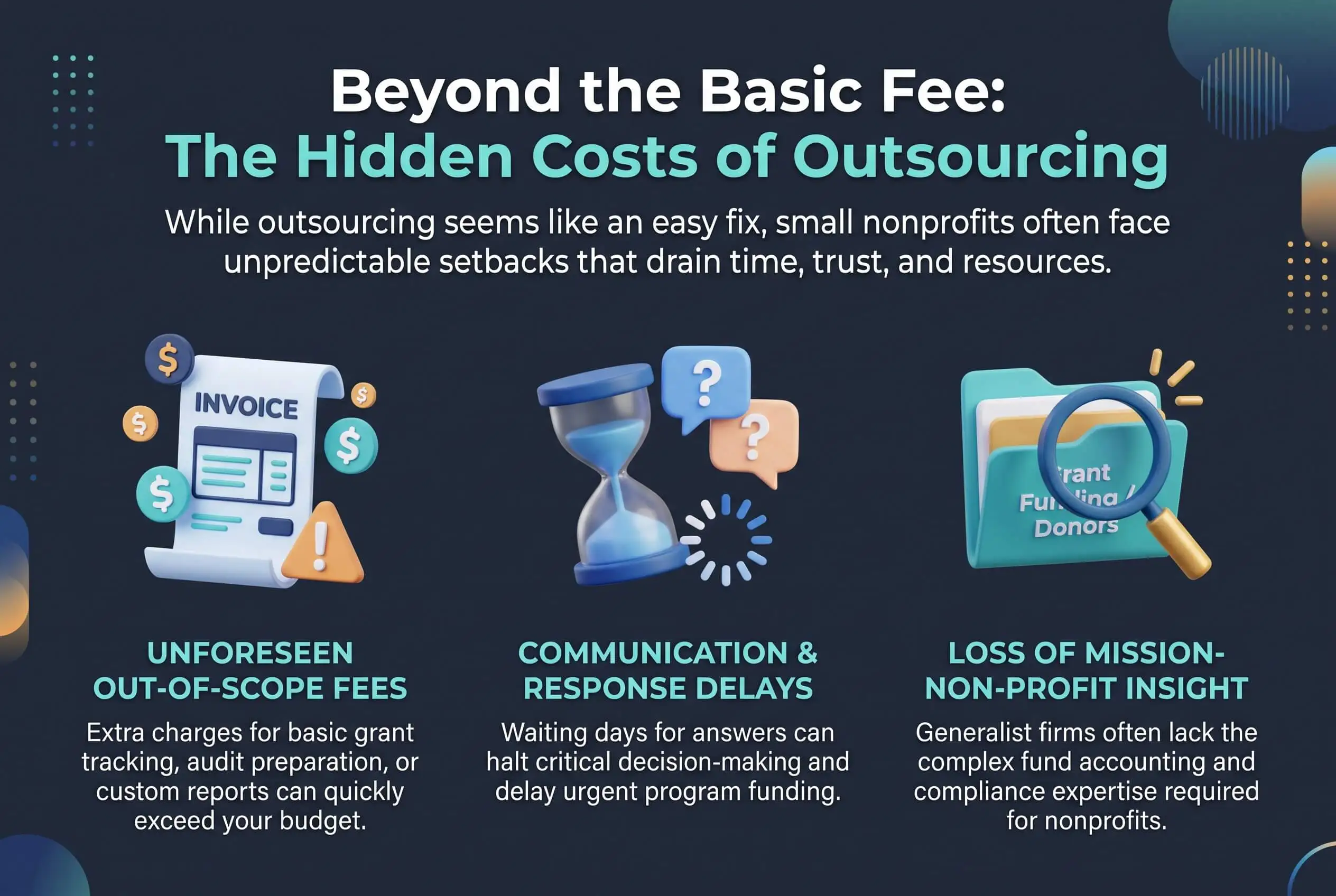
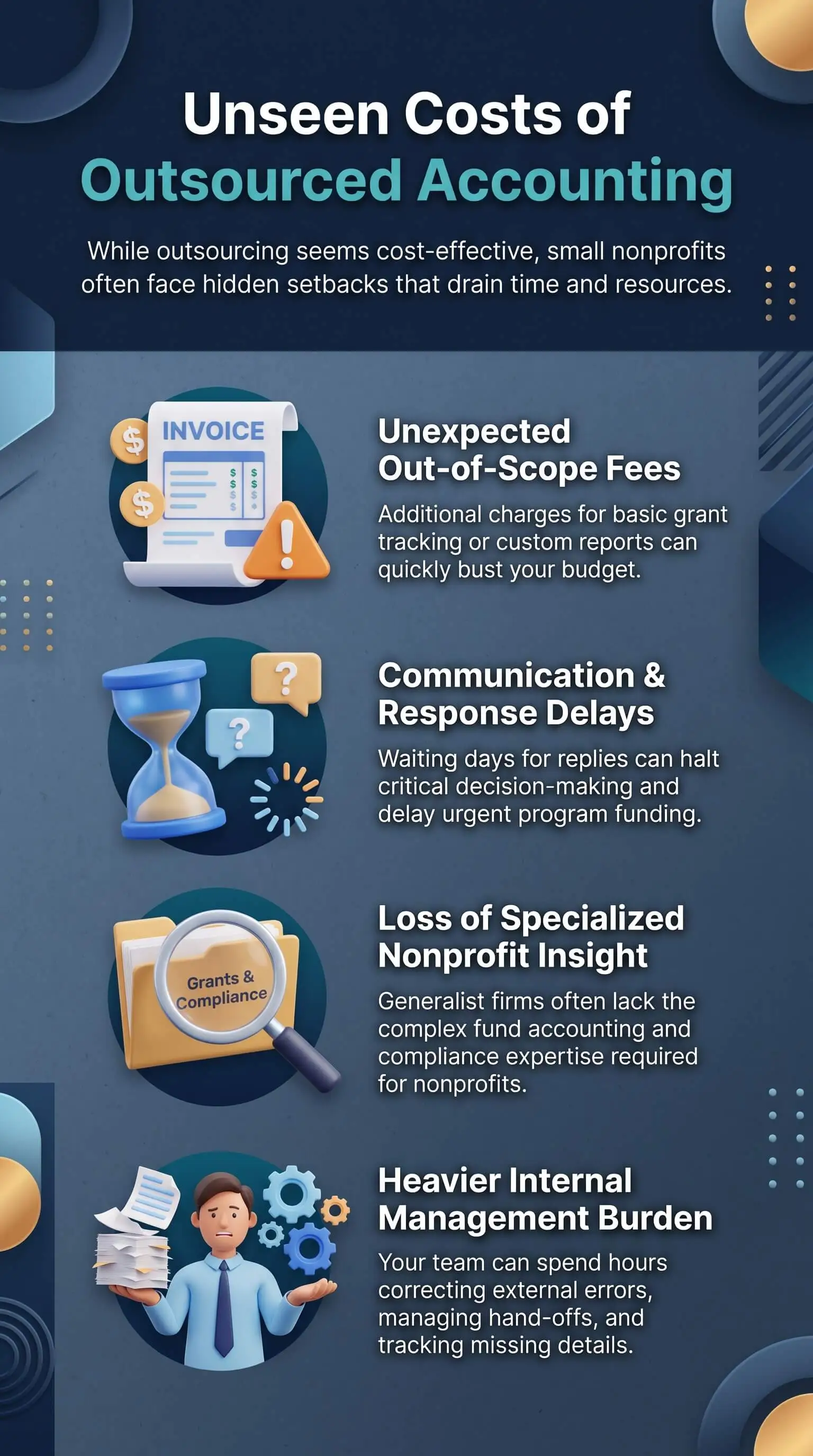
The hidden costs of outsourcing accounting for a small nonprofit sit outside the monthly fee. Expect setup and cleanup work, out-of-scope billing, software subscriptions, audit and Form 990 preparation, and the staff hours it takes to feed the firm information and check its work.
We'd still recommend outsourcing to most small organizations, as long as someone reads the proposal line by line before signing.
Eight Hidden Costs Small Nonprofits Often Miss
1. Onboarding and setup fees. Most firms bill a one-time fee to rebuild the chart of accounts, connect bank and donation platforms, and set up user access. It's legitimate work, though it rarely shows up in the weekly number a board compares against a salary.
2. Catch-up and cleanup work. This is the one we see most. A new firm opens the books and finds months of unreconciled deposits, or a scholarship gift someone booked as general revenue instead of a restricted fund. The firm has to fix that before regular service starts, and most firms bill the cleanup by the hour.
3. Scope creep and hourly overages. Fixed packages cover recurring work like reconciliations and the monthly close. A funder's mid-year report, a board meeting the accountant attends, or a budget revision after a grant falls through tends to sit outside that package, and those requests pile up fast during grant season.
4. Software and subscription stacking. QuickBooks, a donor database like Bloomerang or DonorPerfect, payroll, and bill-pay tools each carry their own fee. Some firms pass per-user licenses through to you. Others require their preferred platform, which can mean paying to switch.
5. Audit, review, and Form 990 preparation. Many firms charge separately for year-end audit support and Form 990 coordination. If your organization spends close to $1,000,000 in federal awards in a year, single audit preparation adds another layer.
6. Internal staff time. Outsourcing moves most of the work out of your office, though never all of it. Someone on your team still gathers receipts, approves payments, codes expenses to the right grant, and answers the firm's questions every week. No invoice shows those hours, but your program staff feel them.
7. Errors from generalist firms. Nonprofit books follow different rules than a small business's books. A firm without fund accounting experience can miss donor restrictions or split program, administrative, and fundraising costs badly, and you'll usually find out during the audit or on an awkward call with a funder.
Specialization prevents most of this. A firm built around outsourced accounting sets up fund and grant tracking before the first close, keeps restricted balances visible month to month, and puts scope in writing. That way the firm catches cleanup issues and classification errors early, while they're still cheap to fix, and your books stay audit-ready.
8. Turnover and exit costs. When the accountant assigned to you leaves the firm, someone new has to learn your books, and you pay for that learning curve one way or another. Ending the relationship can carry its own price in transition fees or a slow data handoff.
How Much Does Outsourced Accounting for Nonprofits Actually Cost?
That depends on transaction volume, how many grants you track, and how clean your books are when the firm starts. Outsourcing can cost about the same as an in-house accountant, more, or a good deal less.
Staff pay is the fairest benchmark. The U.S. Bureau of Labor Statistics puts the median annual wage for accountants and auditors at $81,680 as of May 2024. A hire also brings payroll taxes, benefits, training, and a gap every time that person takes leave or moves on. Most small nonprofits don't need a full-time accountant, which is why a well-scoped firm usually comes in below that figure.
For the comparison to mean anything, count total first-year costs on both sides. Add setup, cleanup, software, and year-end work to the firm's monthly fee, including any additional costs for fractional CFO services, before you hold it up against a salary.
Questions to Ask Before You Sign
A 30-minute call with each firm you're considering will surface most hidden fees. Ask them:
What's excluded from the monthly fee?
How do you bill out-of-scope work, and will you tell us before you bill it?
Will you review our books first and quote any cleanup separately?
Who owns the software licenses and our data if we part ways?
What does audit support and Form 990 coordination cost?
Who'll work on our account, and what happens if that person leaves?
What notice period and fees apply if we end the agreement?
How many nonprofits our size do you work with right now?
Specific answers are a good sign. When a firm gets vague, the costs tend to show up later.
What This Means for Independent Schools
Schools carry more financial moving parts than most small charities. Tuition revenue, financial aid, gifts restricted to scholarships or a building fund, and Schedule E of Form 990 all need careful tracking, which leaves a school especially exposed to cleanup and classification costs if it hires a generalist. Before signing, ask the firm which tuition-based nonprofits it has worked with and how it reports a gift made for one specific purpose.
"Before I founded Accountix, I spent years in cost containment, helping organizations find money they were losing without knowing it. That same lesson holds when a nonprofit picks an outside firm. What usually hurts is the surprise, not the fee. Think of books that need months of cleanup, reports nobody scoped, or a restricted grant someone coded wrong that nobody catches until the audit. So when we start with a nonprofit, we review the books first, put the scope in writing, and set up fund tracking before the first close. Leaders should know what they're paying for on day one instead of finding out in month six."
7 Essential Resources
We leaned on these while putting this guide together, and they're worth a bookmark if you're comparing firms.
Nonprofit Risk Management Center: Outsourcing the Finance or Accounting Function Walks through due diligence before outsourcing and warns that base fees rarely cover everything. It also reminds leaders that oversight stays with them.
National Council of Nonprofits: What Is an Independent Audit? Explains what an audit involves, why the cost can strain a small budget, and when a financial review might do instead.
IRS: About Form 990 The official page for the annual return most exempt organizations file, with Schedule E for schools.
IRS: Charities and Nonprofits Where the IRS keeps exempt organization rules, filing requirements, and compliance updates.
Nonprofit Accounting Basics: Outsourced Accounting Services A neutral rundown of outsourcing models and what to look for in a provider that matches your size.
Candid: What We Know About Very Small Nonprofits Shows that most U.S. 501(c)(3) organizations run on budgets under $50,000. At that size, every outside cost matters.
Nonprofit Law Blog: How Independent Audits and Audit Committees Protect Nonprofits A plain explanation of the board oversight duties that stay in place no matter who keeps the books.
3 Statistics
$81,680 was the median annual wage for accountants and auditors in May 2024. Source: U.S. Bureau of Labor Statistics, Occupational Outlook Handbook. Use it as your baseline when you weigh a firm's total annual cost, and remember a hire adds benefits and payroll taxes on top.
$1,000,000 in federal awards spent in one fiscal year triggers a single audit, for fiscal years beginning on or after October 1, 2024. Source: 2 CFR 200.501, Electronic Code of Federal Regulations. Grant-funded nonprofits near that line should ask early who prepares for the audit and what it costs.
5% of annual revenue is what organizations lose to occupational fraud, by the ACFE's estimate from 2,402 cases. Source: ACFE, Occupational Fraud 2026: A Report to the Nations. Outsourcing doesn't retire the need for someone inside to review the firm's work, and skipping that review can cost far more than any fee.
Final Thoughts and Opinion
For most small organizations, outsourced accounting for nonprofits is the right call. Few can justify a full-time accountant, and relying on one volunteer treasurer for every financial task is a risk no board should carry for long.
When nonprofits tell us an outsourcing arrangement went sideways, the cause is usually the comparison they made at the start rather than the firm itself. They weighed a weekly rate against a salary, skipped the cleanup quote, and assumed grant reporting was part of the package.
So ask for the total first-year cost and get the scope in writing. Pick a firm that already knows fund accounting and the Form 990. And keep your board close to the numbers, because oversight is the one job you can't hand off.
If you're still deciding whether outside help is worth it at all, read the value side of this decision next to this one. With both in view, you can spend less time on the books and more of it on your mission.
Frequently Asked Questions
What are the hidden costs of outsourcing accounting for a nonprofit?
The usual ones are onboarding fees, cleanup of past records, hourly charges for work outside the agreed scope, software subscriptions, and audit or Form 990 preparation. Your own staff's time spent gathering documents and reviewing reports counts too. Ask each firm for total first-year cost and most of these come into view.
How much does outsourced accounting cost a small nonprofit?
It depends on transaction volume, the number of grants you manage, and how clean your books are. Outsourced accounting for nonprofits can cost about the same as an in-house accountant, whose median wage was $81,680 in May 2024, or more, or less. Most small organizations pay less because they only need part-time support.
Is outsourcing accounting cheaper than hiring a bookkeeper?
Often, once you count benefits, payroll taxes, training, and the cost of covering a vacancy. It can run higher if your books need heavy cleanup or the scope keeps growing. Compare total annual cost on both sides instead of a firm's rate against a salary.
Does outsourcing remove the board's financial responsibility?
No. A firm can keep the books and advise leadership, but your board still approves the budget, reviews the financial statements, sets internal controls, and answers to donors for all of it. The arrangement works best when a treasurer or finance committee reads the firm's reports every month.
Can a private school outsource its accounting?
Yes. Most private schools are nonprofits and can use the same outsourced models as other charities. Check that the firm understands tuition revenue, financial aid, restricted gifts, and Schedule E of Form 990, since a generalist may miss them.
When does a small nonprofit need an audit?
That depends on your state, your funders, and any federal money you receive. Federal rules require a single audit once a nonprofit spends $1,000,000 or more in federal awards in a fiscal year. Many states set their own revenue thresholds, so check with your state's charity office.
Get a Clear Picture Before You Sign
Before you sign an outsourced accounting proposal, spend 30 minutes with a nonprofit-focused team and have them look at your books alongside the quote. Ask them to itemize every cost from setup through year-end. You'll either confirm the deal holds up or catch the gaps while they're still easy to fix, and you'll go into the contract knowing exactly what you're paying for.


