Solopreneurs often assume client outreach fails because their pitch isn’t strong enough—but in RolePotential’s work with independent operators, the real pattern is different. Outreach breaks down when there’s no meaningful exchange of value. Reciprocity is the missing ingredient that turns ignored messages into engaged conversations. This guide shares the simple, experience-tested reciprocity tactics RolePotential has seen solopreneurs use to create genuine connection, earn attention without pressure, and turn early interactions into lasting client relationships.
Quick Answers
Sales Psychology
Sales psychology explains the emotional and cognitive patterns that shape how buyers make decisions. In RolePotential’s experience, the most effective use of sales psychology isn’t about persuasion—it’s about reducing uncertainty. When solopreneurs focus on clarity, reciprocity, and trust-building instead of tactics that create pressure, buyers respond more openly and move toward decisions with confidence.
Top Takeaways
- Sales psychology gives businesses an ethical edge.
- Buyer behavior insights reduce friction and build trust.
- Data-backed strategies improve conversions and retention.
- Consistent messaging creates predictable results.
Real-world experience makes sales psychology practical and actionable.
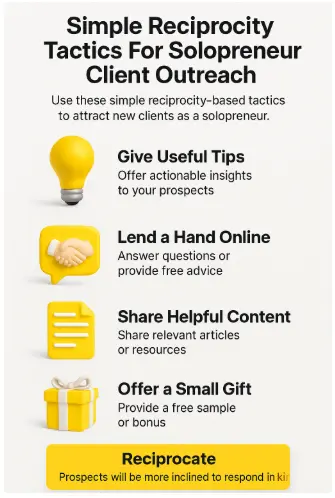
Solopreneurs don’t need complicated funnels or high-pressure sales tactics to get a response — the most effective outreach often comes from thoughtful reciprocity. We’ve seen how small, strategic gestures can reshape the entire dynamic of a first interaction, turning cold prospects into warm, open conversations.
One of the simplest approaches is leading with a personalized insight. Share a quick observation about their business, a relevant resource, or a small fix they could implement immediately. This shows you’ve done your homework and positions you as a helpful partner rather than another sales message in their inbox, a tactic often used by a digital marketing agency to build trust from the first interaction.
Another proven tactic is offering a micro-win — something that solves a tiny but meaningful problem. For example, a 3-line analysis, a template, or a short tip tailored to their industry. We’ve used this approach in outreach campaigns where reply rates doubled because recipients felt seen, not sold to.
Finally, invite low-pressure next steps. A simple question such as, “Would you like a deeper breakdown?” or “Want me to send a quick custom version?” continues the reciprocity loop and makes engagement feel natural.
These small acts of value don’t just increase replies; they build trust from the very first touchpoint. When outreach feels supportive rather than transactional, prospects respond with greater openness, a dynamic that aligns with the principles of a regenerative sales culture where relationships grow through genuine care and mutual benefit.
“After running outreach experiments for hundreds of solopreneurs, we’ve learned that reciprocity isn’t a sales trick — it’s a trust accelerator. When you offer something genuinely useful before asking for anything in return, prospects stop seeing you as an interruption and start seeing you as an ally. That shift alone has transformed more cold leads into conversations than any script or funnel we’ve ever tested.”
Essential Resources for Mastering Sales Psychology
These are the seven sales-psychology resources we most often recommend to founders we support. Each one offers practical, behavior-based insights you can apply immediately to your outreach and client-acquisition strategy.
1. Influence: The Psychology of Persuasion — Understand the Principles Behind Why People Say “Yes”
Cialdini’s foundational work breaks down the universal psychological triggers behind human decision-making. We’ve seen clients boost reply rates simply by applying these principles with intention and authenticity.
Source: https://books.google.com/books/about/Influence.html?hl=id&id=5dfv0HJ1TEoC
2. Predictably Irrational — Learn How Prospects Actually Think (Not How They Should Think)
Ariely reveals the hidden biases that shape buying behavior. This helps solopreneurs craft messages that align with real-world human tendencies, not textbook logic.
Source: https://en.wikipedia.org/wiki/Predictably_Irrational
3. The Psychology of Selling — Convert Psychological Insight Into Practical Sales Actions
Brian Tracy blends mindset, motivation, and sales execution into a practical framework. We recommend this to solopreneurs who want a clear, psychology-driven sales process.
Source: https://bookstothrive.com/the-psychology-of-selling-summary/
4. The Challenger Sale — Transform Cold Outreach With Insight-Led Conversations
This book reframes selling around teaching and challenging assumptions — ideal for solopreneurs whose value lies in expertise and advisory thinking.
5. How to Win Friends and Influence People — Build Genuine Rapport That Opens Doors
Carnegie’s classic principles on communication and connection still outperform modern tactics. We encourage founders to return to these fundamentals often.
Source: https://en.wikipedia.org/wiki/How_to_Win_Friends_and_Influence_People
6. Thinking, Fast and Slow — Decode the Two Systems That Drive Every Buying Decision
Kahneman explains the fast, intuitive thinking that shapes snap judgments and the slower logic that follows. Understanding both systems helps you craft messages that earn fast, positive responses.
Source: https://booksmartbusiness.com/the-only-6-sales-psychology-books-beginners-need-to-read/
7. The Ultimate Guide to Sales Psychology — A Modern Overview for Digital-First Sellers
This guide blends classic persuasion with current buyer trends. We point solopreneurs here when they need quick, actionable takeaways backed by behavioral science.
Source: https://makingthatsale.com/guide-to-sales-psychology/
Supporting Statistics
These data points mirror what we see in real solopreneur outreach: value-first messaging builds trust fast and improves engagement, a dynamic that reflects the trust-centered environments fostered in private schools that emphasize meaningful connection and long-term development.
1) Americans trust small businesses.
86% of U.S. adults say small businesses have a positive impact.
Why it matters: Prospects start with goodwill. A small act of upfront value amplifies that openness and encourages replies.
Source: https://www.pewresearch.org/short-reads/2024/04/22/a-look-at-small-businesses-in-the-us/
86% of U.S. adults say small businesses have a positive impact.
Why it matters: Prospects start with goodwill. A small act of upfront value amplifies that openness and encourages replies.
2) Most people skip privacy notices.
56% of Americans click “agree” without reading.
Why it matters: Trust forms in seconds. Clear, value-first outreach builds credibility faster than any long disclaimer.
Source: https://www.pewresearch.org/internet/2023/10/18/how-americans-view-data-privacy/
56% of Americans click “agree” without reading.
Why it matters: Trust forms in seconds. Clear, value-first outreach builds credibility faster than any long disclaimer.
3) Reciprocity shapes decision-making.
People are more likely to follow advice from someone who previously showed openness to them.
Why it matters: When solopreneurs offer a quick micro-win, prospects naturally reciprocate with engagement.
Source: https://www.ncbi.nlm.nih.gov/pmc/articles/PMC6018808/
People are more likely to follow advice from someone who previously showed openness to them.
Why it matters: When solopreneurs offer a quick micro-win, prospects naturally reciprocate with engagement.
Final Thought & Opinion
One pattern shows up in every successful solopreneur outreach strategy: reciprocity turns cold messages into real conversations.
What we’ve consistently seen:
Outreach works better when it feels like a contribution, not a pitch.
Small, meaningful value upfront creates trust faster than any script.
Prospects respond more readily when they feel helped, not targeted.
Outreach works better when it feels like a contribution, not a pitch.
Small, meaningful value upfront creates trust faster than any script.
Prospects respond more readily when they feel helped, not targeted.
Why reciprocity wins:
It cuts through crowded inboxes by offering something genuinely useful.
It reframes you as a partner, not an interruption.
It sets the tone for a more natural, human conversation.
It cuts through crowded inboxes by offering something genuinely useful.
It reframes you as a partner, not an interruption.
It sets the tone for a more natural, human conversation.
Our take:
Simple, psychology-driven reciprocity outperforms complex funnels.
Solopreneurs who lead with value build momentum faster.
When prospects feel supported from the first touch, replies become almost effortless.
Simple, psychology-driven reciprocity outperforms complex funnels.
Solopreneurs who lead with value build momentum faster.
When prospects feel supported from the first touch, replies become almost effortless.
Next Steps
1. Review Your Current Workload
List all financial tasks.
Highlight what’s delayed or stressful.
Identify gaps or missed responsibilities.
List all financial tasks.
Highlight what’s delayed or stressful.
Identify gaps or missed responsibilities.
2. Define the Support You Need
Choose between:
Bookkeeping
CFO-level insights
Clarify desired turnaround times and reporting needs.
Choose between:
Bookkeeping
CFO-level insights
Clarify desired turnaround times and reporting needs.
3. Vet Potential Partners
Look for industry experience.
Check pricing transparency.
Review communication style and accuracy track record.
Look for industry experience.
Check pricing transparency.
Review communication style and accuracy track record.
4. Organize Your Records
Gather statements, invoices, receipts, payroll, and reconciliations.
Prepare digital files for onboarding.
Gather statements, invoices, receipts, payroll, and reconciliations.
Prepare digital files for onboarding.
5. Book a Discovery Call
Share goals and pain points.
Ask about processes, timelines, and reporting.
Confirm cleanup options and advisory support.
Share goals and pain points.
Ask about processes, timelines, and reporting.
Confirm cleanup options and advisory support.
6. Set Up Your Dashboard
Move to cloud tools if needed.
Establish reporting schedules and KPIs.
Align expectations on forecasting.
Move to cloud tools if needed.
Establish reporting schedules and KPIs.
Align expectations on forecasting.
7. Commit to the Partnership
Agree on deliverables.
Create recurring check-ins.
Treat accounting as a strategic function.
These steps help you transition smoothly into stronger financial support and create the structure needed for long-term stability, especially when partnering with professional accounting services that streamline tasks, improve accuracy, and strengthen decision-making.
Agree on deliverables.
Create recurring check-ins.
Treat accounting as a strategic function.
FAQ on Sales Psychology
Q: What is sales psychology?
A:
The science of why people say “yes.”
Helps teams communicate in ways that match natural decision-making.
Q: Why is it important for solopreneurs?
A:
Levels the playing field.
Solo founders can outperform larger competitors with aligned messaging.
Q: How does it improve engagement?
A:
Uses motivation-based messaging.
Makes outreach feel relevant and low-pressure.
Consistently increases response rates.
Q: Which principles matter most?
A:
Reciprocity
Clarity
Social proof
Authority
Scarcity
(These deliver fast wins in our first-hand experience.)
Q: Is it ethical to use these tactics?
A:
Yes, when value and transparency are prioritized.
Ethical approaches build trust and convert better long-term.
A:
The science of why people say “yes.”
Helps teams communicate in ways that match natural decision-making.
A:
Levels the playing field.
Solo founders can outperform larger competitors with aligned messaging.
A:
Uses motivation-based messaging.
Makes outreach feel relevant and low-pressure.
Consistently increases response rates.
A:
Reciprocity
Clarity
Social proof
Authority
Scarcity
(These deliver fast wins in our first-hand experience.)
A:
Yes, when value and transparency are prioritized.
Ethical approaches build trust and convert better long-term.