A family foundation can give away millions over twenty years and still leave the next generation nothing to follow but a stack of old checks. Philanthropic planning closes that gap. It turns a family's values into a written giving strategy with a mission, focus areas, grant guidelines, and chosen giving vehicles, then adds clear roles and records clean enough for the next generation to steward.
Most families who start a foundation are already generous. Structure is what they tend to lack. Without it, the grant calendar follows whoever called last, and the board approves its biggest gifts in a rush during the second week of December. Acknowledgement letters end up split between two inboxes and a desk drawer. When the founder is ready to step back, there's often very little on paper to hand over.
Good family foundation management and philanthropic planning services start well before the board approves its first grant. It starts with a plan the whole family can read in one sitting and agree to.
TL;DR Quick Answers
Family Foundation Management and Philanthropic Planning Services
Family foundation management is the ongoing work of running a family's foundation: grants, board meetings, payout, filings, and records. Philanthropic planning services set the strategy that work follows. Together, they turn a family's values into giving the family something to repeat, document, and hand to the next generation.
What planning covers: mission, focus areas, grant guidelines, giving vehicles, family roles, and succession.
What management covers: grant tracking, board coordination, the 5% annual payout, Form 990-PF filing, and clean records.
Who does what: your CPA and attorney give tax and legal advice. A planning team coordinates strategy and implementation around them.
When families add support: giving has grown without structure, a liquidity event or wealth transfer is underway, or the next generation is ready to take part.
The payoff: fewer year-end scrambles, clearer decisions, and a foundation that outlasts its founder.
Top Takeaways
Philanthropic planning turns family values into a written giving strategy.
A full plan covers mission, focus areas, vehicles, governance, compliance, and succession.
Many families pair a private foundation with a donor-advised fund.
Private foundations generally have to pay out at least 5% of assets a year.
Bringing the next generation in early keeps a foundation going after the founder steps back.
Why a Family Foundation Needs a Plan
Generosity is common. A giving strategy the family can repeat year after year is much rarer, and the gap shows up in four places.
Focus. Without a plan, the foundation answers requests in the order they arrive. With one, the board measures every request against a written mission.
Structure. Unplanned giving uses entities case by case. Planned giving assigns each vehicle a defined job.
Tax timing. The year-end scramble gives you a way to coordinate with your CPA starting in January.
Records. Receipts stop living in several places at once. One organized system holds grants, letters, and board decisions.
In our experience, families who plan tend to give more over time, especially when family office trust and business transition services help connect their giving with broader trust, succession, and business planning. Each gift is easier to approve and easier to explain to the rest of the family.
The Six Parts of a Philanthropic Plan
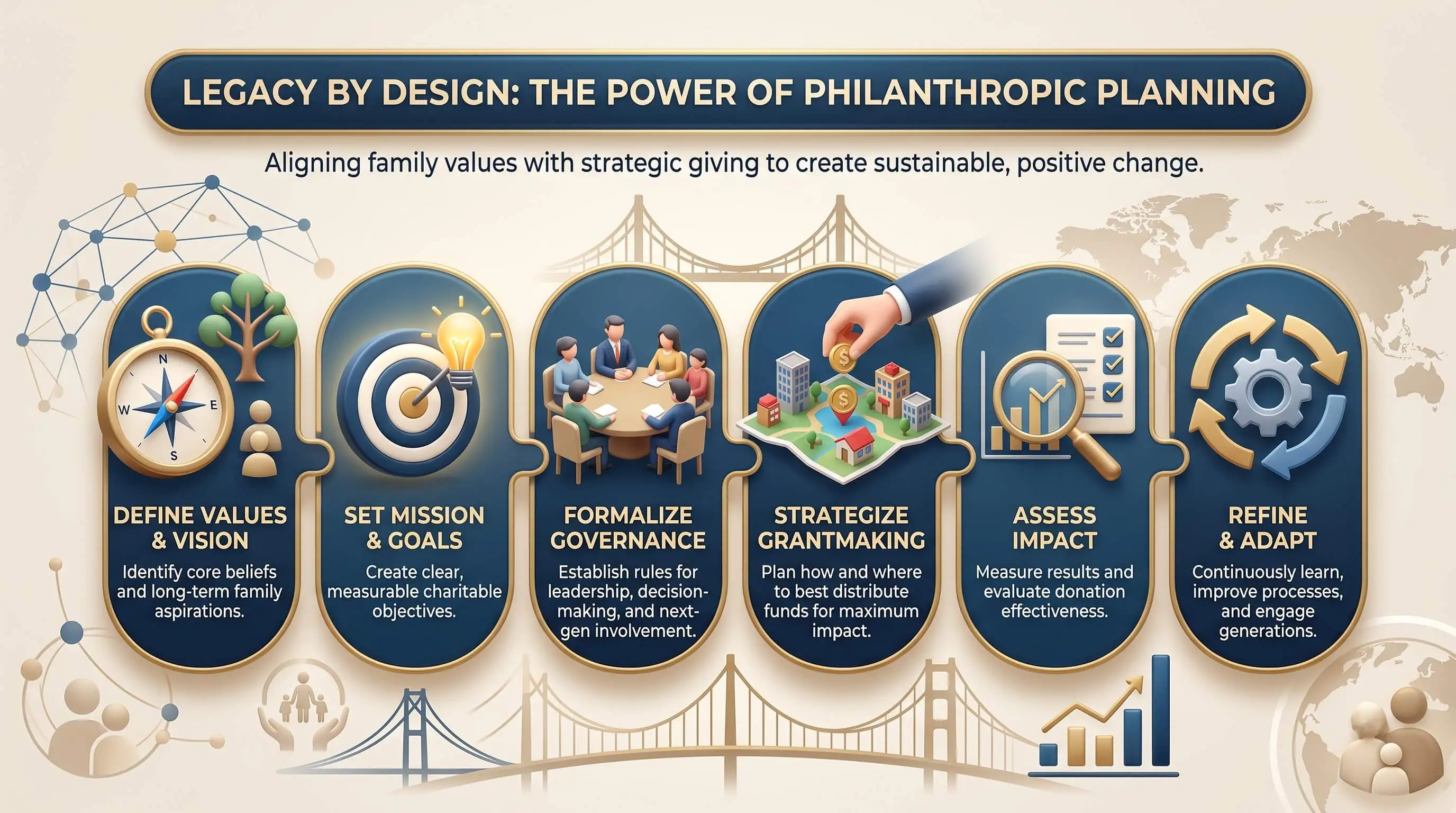
A complete plan answers six questions. None of them needs a binder, and a page or two apiece is plenty.
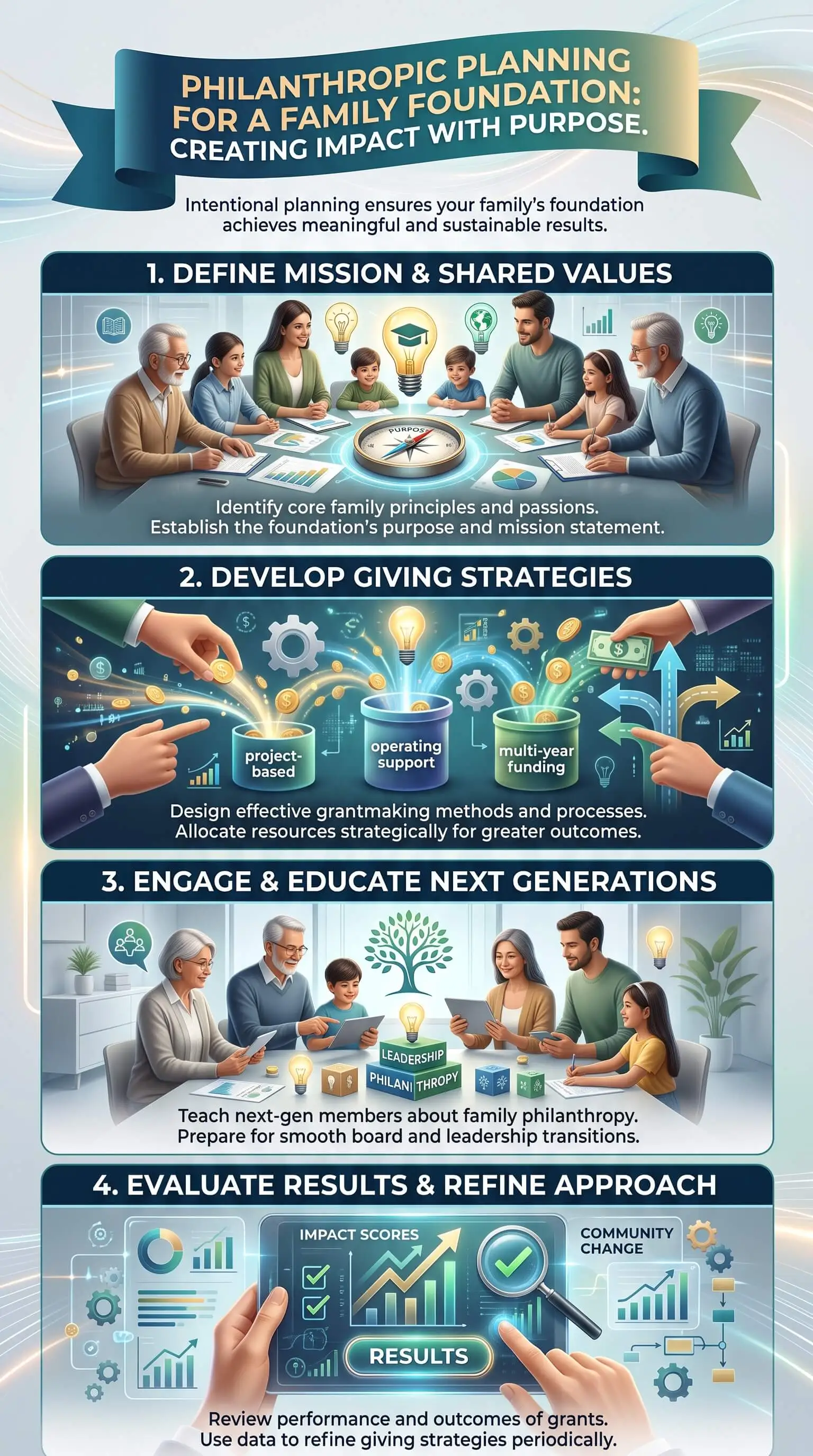
Mission and values. Why the family gives and what it hopes will change. The board holds every grant request up against this statement.
Focus areas and grant strategy. Two to four issue areas, the communities you serve, the kinds of grants you'll make, and how the board reviews requests.
Giving vehicles. Which structures the family uses and the job each one does.
Governance and family roles. Who sits on the board, how votes work, how the family handles conflicts of interest, and how new members come on.
Compliance and recordkeeping. A calendar for payout, filings, board minutes, and grant documentation.
Next-generation engagement and succession. How heirs learn the work, when they get a vote, and who leads once the founder steps back.
Choosing the Right Giving Vehicles
Pick vehicles by two measures: how much control the family wants and how much administration it's willing to carry. Most families end up using more than one.
Donor-advised fund. The family recommends grants and the sponsoring charity gives final approval. Paperwork stays light, which suits families who want simple, flexible annual giving.
Private family foundation. A family board makes the decisions. In exchange, the foundation files an annual return and follows payout rules, so it fits families who want a lasting institution with its own governance.
Charitable remainder or lead trust. The trust document sets the terms, and your attorney and CPA draft it together. These trusts make the most sense when giving ties into estate or income planning.
Direct gifts. Full control and almost no setup. Tracking gets harder once the family writes dozens of checks a year.
One pairing we see often is a private foundation for long-term, family-governed grantmaking alongside a donor-advised fund for smaller or faster gifts, with outsourced family office executive services helping coordinate the administration and keep the moving parts aligned. Your attorney and CPA should confirm the right mix for your situation.
How Planning Shapes Family Foundation Management
Once the family writes its priorities down, the foundation's year gets predictable. Grant cycles, board meetings, and filings run on a schedule instead of on deadlines.
Compliance sits on that same calendar. A private non-operating foundation generally has to distribute at least 5% of its prior-year noncharitable-use assets each year. Miss that mark and the IRS applies an initial 30% excise tax on the shortfall, plus an additional 100% tax if the foundation doesn't correct it, as PKF O'Connor Davies explains. Every foundation also files Form 990-PF each year and keeps records showing that each grant served a charitable purpose.
Many families run this work through a family office, where giving decisions connect to estate planning, tax strategy, and wealth transfer. That's the role philanthropic planning services fill. One team brings investment-level discipline to the family's giving, keeps the strategy and records current, and keeps your advisors working from the same plan. Your CPA and attorney remain the technical experts. We coordinate the strategy and implementation around them.
This article is for education and isn't tax or legal advice.
Planning Foundation Gifts to Schools and Scholarships
Education is one of the most common places family foundations give. In 2025 it drew 14% of all U.S. charitable giving, according to Candid's summary of the Giving USA report.
A plan makes those gifts go further. Before the foundation commits funds, confirm the school's tax-exempt standing. Our guide to the nonprofit status of private schools covers the basics. Then put the intended use in writing and agree on when the school will report back.
Scholarships take extra care. If a private foundation awards private school scholarships directly to students, the IRS generally has to approve its selection procedure in advance. Many families skip that step by funding scholarships through the school or an established scholarship organization, which then picks the recipients.
A named scholarship, an endowment gift, a building pledge, or a one-time program grant all benefit from clear written terms. Those terms protect the family's intent and let the school plan with confidence.
"The foundations that hold together over decades usually aren't the biggest ones. They're the ones where the mission is written down and the grandchildren have been sitting in on meetings since they were teenagers. Once a family answers the hard questions on paper, a difficult grant request turns into a conversation instead of an argument. That's what a plan buys you."
7 Essential Resources
NCFP: Trends in Family Philanthropy 2025. The National Center for Family Philanthropy runs this benchmark study every five years, and it's the best single look at how family foundations actually govern and give.
NCFP: Practices for Engaging the Next Generation. Concrete ways to bring heirs into giving decisions, drawn from working family foundations.
FSG: Crafting a Strategic Plan for Your Family Foundation. Five questions a family board can work through to get from good intentions to a written strategy.
Guardian: Creating a Family Philanthropy Plan. A plain-language walkthrough that's especially useful on how long a foundation should last.
PKF O'Connor Davies: Understanding the 5% Payout Rule. A CPA firm's explanation of minimum distributions and what happens when a foundation falls short.
Central Florida Foundation: How to Begin Your Family Philanthropy. Good reading for families giving together across generations for the first time.
Giving USA 2026 Annual Report Release. The latest national figures on who gave in 2025 and where the money went.
Supporting Statistics
$117.15 billion. Foundations gave that much in 2025, about 19% of all U.S. charitable giving, according to Giving USA 2026 data summarized by Stelter. A plan decides where each family's share of that money goes.
86% versus 26%. The National Center for Family Philanthropy found that 86% of family foundations encourage the next generation to take part. Only 26% say next-generation engagement ranks among the board's top three uses of time. Intentions like that need a plan behind them before they turn into continuity.
71%. Most family foundations now give more than the required 5% each year, according to Giving Compass's summary of NCFP's Trends 2025 report. For these families, the grant budget is a deliberate choice rather than a legal floor.
Final Thoughts
We'll say it plainly. A family foundation without a written plan drifts toward reactive checks, however generous those checks are. Give the same foundation a plan, and the family can explain it to a new board member in ten minutes and hand it to the next generation without a scramble.
The turning point in our work is rarely a tax question. It's usually a kitchen-table conversation about what the family actually cares about. After that, choosing vehicles and setting a grant budget become routine work. The compliance calendar is honestly the easy part.
Good family foundation management starts with the plan. The paperwork has to be right, and we take it seriously, but it serves the family well only when it follows a clear purpose.
Frequently Asked Questions
What does philanthropic planning include?
A philanthropic plan covers the family's mission, its focus areas, grant guidelines, the giving vehicles it uses, board and family roles, a compliance calendar, and a path for bringing in the next generation. Put together, those pieces give the family a strategy it can follow every year and eventually hand down.
How is philanthropic planning different from simply donating?
Donating answers requests one at a time. Planning decides ahead of time what the family supports, how much it gives, which structures it uses, and who makes the call. The giving that results is easier to document and ties directly into the family's tax and estate planning.
Does a family foundation have to give away a set amount each year?
Yes. A private non-operating foundation generally has to distribute at least 5% of its prior-year noncharitable-use assets each year. If it falls short, the IRS applies an initial 30% excise tax on the undistributed amount and can add a 100% tax if the foundation doesn't correct it. Have your CPA confirm the figure every year.
Should a family use a donor-advised fund or a private foundation?
That depends on how much control and administration the family wants. A donor-advised fund is simpler and costs less to run, though the sponsoring charity has final say on grants. A private foundation gives the family full governance and a lasting institution in exchange for more filings and rules. Plenty of families use both.
How can families involve children in foundation decisions?
Start early and keep the door open. Some families bring children on site visits or hand them a small grant budget. Others set up a junior board, or invite teenagers to sit in on regular board meetings. As heirs gain experience they can move onto the main board, and writing those steps into the plan turns succession into a process rather than a surprise.
Can a family foundation fund private school scholarships?
Yes. The simplest route is funding scholarships through the school or a scholarship organization that selects the recipients. If the foundation picks students itself, the IRS generally has to approve its selection procedure in advance. Either way, put the terms and reporting expectations in writing before any money moves.
Who provides tax and legal advice for a family foundation?
Licensed professionals do. The family's CPA handles tax questions and its attorney handles legal structure. A philanthropic planning team coordinates the strategy, records, and implementation with both of them, so everyone works from the same plan.
Build a Giving Strategy Your Family Can Carry Forward
Put your family's giving on paper, starting with the mission. The right structures and records follow from there. Our team provides multi family office wealth management services and coordinates that work alongside your CPA and attorney so the plan keeps moving and nothing falls between advisors. Schedule a private consultation when the timing is right for your family. There's no obligation.